June 2, 2026
Customer Match Email Validation: Clean Ad Audiences Before Uploading in 2026
First-party audiences are only as strong as the identifiers you upload. Validate email lists before hashing them so paid media teams can remove unreachable contacts, repair typos, and stop ad spend from chasing bad records.
Executive Summary
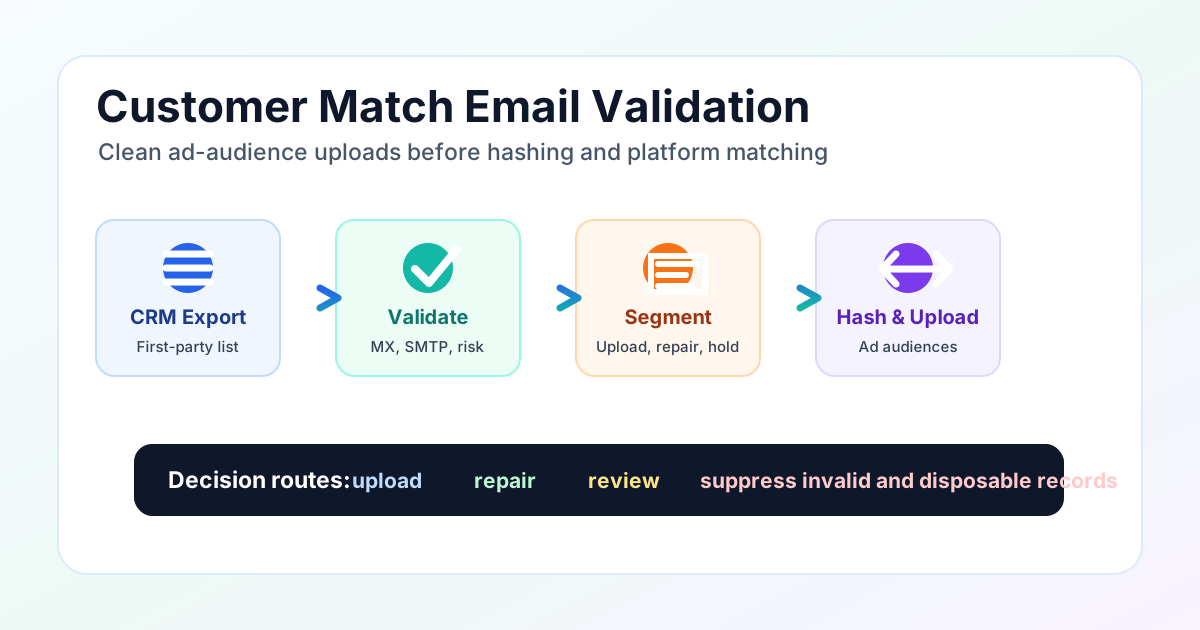
Validate ad-audience email lists before hashing. Google, Meta, LinkedIn, and CDP destinations can process hashed identifiers, but they cannot repair a bad address after it is hashed. The practical workflow is: export consented records, validate in bulk, split upload-ready records from repair/review/suppress records, hash the approved set, then measure match rate and cost per usable contact after upload.
What is Customer Match email validation?
Customer Match email validation is the quality-control step that happens before a CRM, CDP, or ecommerce list is hashed and uploaded to an ad platform. Instead of treating every email field as a usable identifier, the team checks whether the address is well formed, has DNS and MX records, can pass SMTP reachability checks, looks disposable, contains a typo, or carries a risk score that should hold it out of paid media.
The timing matters. Google describes Customer Match as a process where uploaded email and phone identifiers are compared to account identifiers after hashing.LinkedIn Lead Sync documentation describes syncing leads directly to destinations such as marketing automation platforms, CRMs, and CDPs. Those systems are built for matching and movement, not for repairing your CRM. If you uploadbuyer@gmial.com, the platform can hash it, but the typo still costs you audience reach.
Why paid media needs clean email identifiers in 2026
Paid media has moved closer to first-party data. Privacy changes, conversion modeling, and platform automation all make your owned customer records more important. The problem is that CRM audiences usually contain several record types at once: active customers, unsubscribed contacts, stale demo leads, partner imports, event lists, role addresses, consumer mailboxes, and trial signups that used temporary inboxes.
That mix creates a measurement problem. A low match rate might mean the platform cannot find those users. It might also mean the source list had typos, old domains, unreachable mailboxes, or records that should have been suppressed before upload. Validation gives the paid media team reason codes before they blame the ad platform or the CDP connector.
Ad audience hygiene workflow
The workflow is intentionally simple. Export only consented first-party contacts. Validate the list while the email address is still visible. Repair obvious typos. Suppress records that would not produce useful ad matches. Normalize the approved addresses, hash them, upload the cleaned segment, and compare the result against the raw-list baseline.
Customer Match upload vs raw CRM list
| Audience workflow | Risk in a raw export | How validation helps |
|---|---|---|
| Google Customer Match | A malformed or stale address hashes cleanly, but it still cannot match a signed-in account. | Validate, normalize, and hash only records with usable delivery and risk signals. |
| Meta customer list audiences | A raw CRM export can mix good customers with role inboxes, typos, old event leads, and disposable signups. | Create upload, repair, review, and suppress segments before the CSV leaves the CRM. |
| LinkedIn Matched Audiences | B2B lists often include work emails, personal inboxes, aliases, and catch-all domains. | Keep business-domain context while holding uncertain SMTP and low-score records for review. |
| Suppression and exclusion lists | Invalid exclusions waste no send volume, but they weaken ad-audience logic and audience diagnostics. | Clean customer, churn, demo, and competitor-exclusion lists with the same rules as target lists. |
Email validation signals for ad audience quality
Email-Check.app gives paid media and RevOps teams a practical signal set for audience quality: RFC-style syntax, DNS and MX records, SMTP mailbox verification without sending, disposable-domain detection, typo correction, name extraction, domain age, consumer-provider detection, role-account hints, and a score that can drive routing. The point is not to make the ad platform perfect. The point is to prevent obviously bad identifiers from reaching it.
For example, a lifecycle team might validate 100,000 lapsed customers before a win-back campaign. If 12 percent of the raw file is invalid and bulk cleaning brings the usable invalid rate near 1.8 percent, the upload is cleaner, the exclusion list is more reliable, and the team can report exactly which acquisition sources generated throwaway or typo-heavy records.
Routing rules before hashing
| Route | Validation criteria | Paid media action |
|---|---|---|
| Upload | Valid syntax, MX exists, SMTP is reachable or high confidence, no disposable signal, score at or above 75. | Hash and upload to the ad platform or sync through the CDP destination. |
| Repair | Likely typo such as gmial.com, yaho.com, hotmial.com, or missing domain characters. | Prompt correction, fix the CRM record after confirmation, then revalidate before upload. |
| Review | Catch-all domain, uncertain SMTP, role account, low score, or policy-sensitive source. | Hold from costly audiences until RevOps or paid media approves the segment. |
| Suppress | Malformed address, missing MX, disposable domain, confirmed unreachable mailbox, or synthetic pattern. | Exclude from upload and write a reason code for source-quality reporting. |
API example for one audience record
Use the API to validate a record before it enters an audience-sync job. This request checks the same signals you would care about for a campaign list: syntax, MX, SMTP, typo suggestion, name extraction, and domain context.
curl -G "https://api.email-check.app/v1-get-email-details" \
  -H "accept: application/json" \
  -H "x-api-key: YOUR_API_KEY" \
  --data-urlencode "email=buyer@gmial.com" \
  --data-urlencode "verifyMx=true" \
  --data-urlencode "verifySmtp=true" \
  --data-urlencode "suggestDomain=true" \
  --data-urlencode "detectName=true" \
  --data-urlencode "checkDomainAge=true"
JavaScript routing example
The route should be local to the workflow. A paid-media upload can be stricter than a newsletter signup because every bad record weakens audience size, spend diagnostics, and source-quality reporting.
type AudienceValidationResult = {
  email: string;
  validFormat: boolean;
  validMx: boolean | null;
  validSmtp: boolean | null;
  isDisposable: boolean;
  isFree?: boolean;
  score?: number;
  domainSuggestion?: { suggested?: string | null } | null;
};

type AudienceRoute = "upload" | "repair" | "review" | "suppress";

export function routeAudienceRecord(result: AudienceValidationResult): AudienceRoute {
  if (!result.validFormat || result.domainSuggestion?.suggested) {
    return "repair";
  }

  if (!result.validMx || result.isDisposable) {
    return "suppress";
  }

  if (!result.validSmtp || (result.score ?? 0) < 75) {
    return "review";
  }

  return "upload";
}

export async function validateForAudienceUpload(email: string) {
  const params = new URLSearchParams({
    email,
    verifyMx: "true",
    verifySmtp: "true",
    suggestDomain: "true",
    detectName: "true",
    checkDomainAge: "true",
  });

  const response = await fetch("https://api.email-check.app/v1-get-email-details?" + params, {
    headers: {
      accept: "application/json",
      "x-api-key": process.env.EMAIL_CHECK_API_KEY ?? "",
    },
  });

  if (!response.ok) {
    throw new Error("Email validation failed");
  }

  const result = (await response.json()) as AudienceValidationResult;

  return {
    result,
    route: routeAudienceRecord(result),
  };
}
Python bulk cleaning and hashing example
Validate before hashing so typo recovery and suppression reasons stay visible. After the clean route is decided, the script hashes only records that are acceptable for upload or review.
import csv
import hashlib
import requests

API_KEY = "YOUR_API_KEY"

def validate(email: str) -> dict:
    response = requests.get(
        "https://api.email-check.app/v1-get-email-details",
        headers={"accept": "application/json", "x-api-key": API_KEY},
        params={
            "email": email,
            "verifyMx": "true",
            "verifySmtp": "true",
            "suggestDomain": "true",
            "detectName": "true",
            "checkDomainAge": "true",
        },
        timeout=10,
    )
    response.raise_for_status()
    return response.json()

def sha256_email(email: str) -> str:
    return hashlib.sha256(email.strip().lower().encode("utf-8")).hexdigest()

with open("crm-audience.csv", newline="") as source, open("customer-match-ready.csv", "w", newline="") as target:
    reader = csv.DictReader(source)
    writer = csv.DictWriter(target, fieldnames=["hashed_email", "email_route", "email_score"])
    writer.writeheader()

    for row in reader:
        result = validate(row["email"])
        has_typo = bool(result.get("domainSuggestion"))
        risky = result.get("validSmtp") is False or result.get("score", 0) < 75

        if has_typo or result.get("isDisposable") or result.get("validMx") is False:
            continue

        writer.writerow({
            "hashed_email": sha256_email(row["email"]),
            "email_route": "review" if risky else "upload",
            "email_score": result.get("score", 0),
        })
ROI model for clean ad audiences
The ROI case is not only about match rate. It is about wasted ad spend, weak exclusion lists, poor seed audiences, and slow feedback to the source systems that created the bad records. A simple model works well: multiply your invalid audience percentage by the monthly spend attached to that audience, then add the cost of sales follow-up, CRM storage, lifecycle messages, and reporting time spent on records that should never have moved forward.
If a team spends $60,000 per month on retargeting and 10 percent of the source list is unreachable, typoed, or disposable, the obvious waste is $6,000. The real cost is larger when bad identifiers also weaken lookalike seeds, fail to suppress existing customers, or hide which acquisition partner is producing poor data. Validation turns that hidden cost into source-level evidence.
Where this fits in the Email-Check.app stack
Use bulk data cleansing before large audience uploads, email validation for the underlying signal model, disposable email detection for temporary inbox defense, and bounce-rate reduction when the same audience will also receive email campaigns. Related playbooks include paid lead list validation, identity resolution data quality, and suppression automation.
FAQ
Should I upload invalid emails if the ad platform hashes them?
No. Hashing protects the identifier in transit, but it does not make the identifier useful. Invalid and disposable emails still reduce audience quality and make match-rate diagnosis harder.
Does email validation replace consent checks?
No. Validation is a data-quality control, not a consent system. Keep consent, policy, and regional privacy checks in your CRM or CDP workflow before any advertising upload.
How often should ad audiences be revalidated?
Validate before major uploads, before quarterly audience refreshes, after CRM migrations, and whenever a partner, event, or lead source shows unusual disposable, typo, or invalid rates.
Build a cleaner ad-audience file
Validate CSV uploads, split records by route, and keep bad identifiers out of Customer Match, custom audiences, and matched audience workflows.