May 22, 2026
New Domain Email Risk Scoring: Catch AI-Generated Temporary Domains in 2026
Disposable email abuse is shifting from obvious throwaway brands to short-lived domains with working MX records. Use domain age, SMTP, disposable detection, typo correction, and risk scoring together before a suspicious signup becomes a fake account, coupon abuser, or polluted CRM record.
What is new-domain email risk scoring?
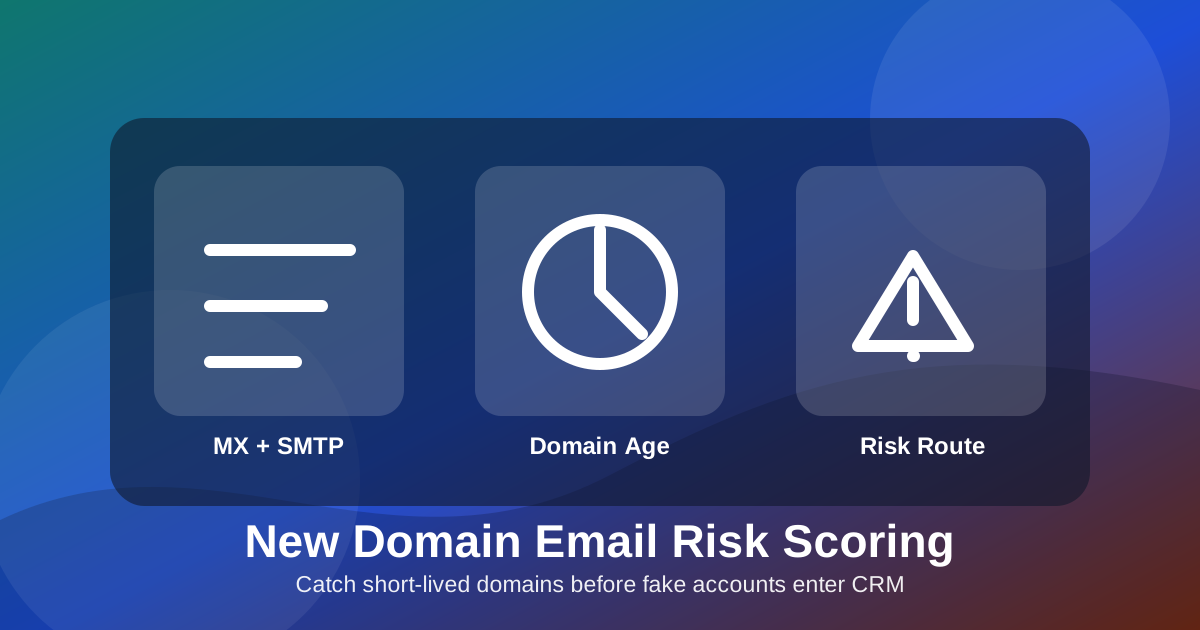
New-domain email risk scoring is the practice of checking how trustworthy an email domain looks before you accept a signup, route a lead, or send a campaign. It does not block every unfamiliar domain. It combines domain age, DNS and MX records, SMTP reachability, disposable status, typo suggestions, free or business domain classification, and a quality score so the product can choose the right action.
That distinction matters in 2026. Static disposable email domains lists still catch known providers, but abuse teams now see domains that exist just long enough to pass a form. A domain can have MX records, accept a verification email, and still be a poor account signal. The safer pattern is layered validation at the moment of capture, followed by bulk review for older records that already entered your database.
Why static disposable checks are not enough in 2026
A blocklist is useful, but it is late by design. Someone has to observe the domain, classify it, publish the update, and push it into production. During that window, fake accounts can claim trials, join referral programs, download gated assets, submit order forms, and create sales work that never turns into revenue.
Competitor pages and recent industry discussions point to the same buyer concern: marketers still care about reducing bounce rate, but growth teams increasingly ask how to prevent fake account creation before bad data reaches CRM. The answer is not a single magic flag. It is a decision model that treats domain age as a fraud signal without confusing a brand-new legitimate startup with a disposable mailbox.
Validation workflow
RFC 5322 syntax check
DNS and MX verification
SMTP mailbox signal
Disposable domain detection
Typo correction
Domain age review
Risk score and routing
How to reduce fake signups with domain age and validation signals
Start with the form intent. A newsletter signup, a B2B demo request, an e-commerce order, and a SaaS trial do not carry the same risk. The same email signal can deserve different treatment depending on what happens after submit. A new domain on a newsletter can go to review. A new domain on a trial that includes credits, coupons, or usage-based infrastructure should face stricter controls.
A practical policy has four outcomes: allow, prompt correction, review, and block. Prompt correction for typos such as gmial.com. Block domains with no MX records or known disposable status. Review new domains, uncertain SMTP results, and low risk scores. Allow addresses with valid syntax, reachable infrastructure, healthy domain age, and clean scoring.
| Signal | Risk | Recommended action |
|---|---|---|
| Domain created in the last 7 days | High | Review or block in trial, referral, coupon, and high-value signup flows. |
| New domain with valid MX but weak SMTP confidence | Medium | Let low-risk newsletters proceed, but hold account creation or CRM routing for review. |
| Old business domain with valid MX and SMTP | Low | Accept, enrich, and route to sales or lifecycle messaging. |
| Known disposable domain | Critical | Block or require stronger identity checks before continuing. |
API example: validate emails without sending
Email-Check.app validates a single email through the public email details endpoint. The request can enable MX verification, SMTP verification, typo suggestions, name detection, and domain age checks. The product can then store the result on the account, lead, or checkout attempt before other systems act on the address.
curl -G "https://api.email-check.app/v1-get-email-details" \
  -H "accept: application/json" \
  -H "x-api-key: YOUR_API_KEY" \
  --data-urlencode "email=trial@new-domain-example.com" \
  --data-urlencode "verifyMx=true" \
  --data-urlencode "verifySmtp=true" \
  --data-urlencode "suggestDomain=true" \
  --data-urlencode "detectName=true" \
  --data-urlencode "checkDomainAge=true"
JavaScript risk routing
Keep the validation decision close to the signup flow. The API supplies the signals; your policy decides how strict to be for the current workflow.
type EmailSignal = {
  validFormat: boolean;
  validMx: boolean | null;
  validSmtp: boolean | null;
  isDisposable: boolean;
  isFree: boolean;
  score?: number;
  domainAge?: { ageInDays?: number; isValid?: boolean };
  domainSuggestion?: { suggested?: string | null; confidence?: number } | null;
};

type SignupDecision = "allow" | "prompt_correction" | "review" | "block";

export function routeSignup(signal: EmailSignal): SignupDecision {
  const ageInDays = signal.domainAge?.ageInDays;
  const isNewDomain = typeof ageInDays === "number" && ageInDays < 30;

  if (!signal.validFormat || signal.domainSuggestion?.suggested) {
    return "prompt_correction";
  }

  if (!signal.validMx || signal.isDisposable) {
    return "block";
  }

  if (isNewDomain || !signal.validSmtp || (signal.score ?? 0) < 70) {
    return "review";
  }

  return "allow";
}
Python review queue
Fraud, lifecycle, and RevOps teams can use the same signal model in back-office jobs. That keeps historical signups, partner lists, and campaign uploads aligned with the real-time form policy.
import requests

API_KEY = "YOUR_API_KEY"

def validate_signup(email: str) -> dict:
    response = requests.get(
        "https://api.email-check.app/v1-get-email-details",
        headers={"accept": "application/json", "x-api-key": API_KEY},
        params={
            "email": email,
            "verifyMx": "true",
            "verifySmtp": "true",
            "suggestDomain": "true",
            "detectName": "true",
            "checkDomainAge": "true",
        },
        timeout=10,
    )
    response.raise_for_status()
    return response.json()

result = validate_signup("buyer@fresh-example-domain.com")
age = (result.get("domainAge") or {}).get("ageInDays")
score = result.get("score", 0)

if result.get("isDisposable") or result.get("validMx") is False:
    action = "block"
elif isinstance(age, int) and age < 30:
    action = "review_new_domain"
elif result.get("validSmtp") is False or score < 70:
    action = "review"
else:
    action = "allow"

print({"email": result["email"], "action": action, "score": score, "domainAge": age})
Real-time validation vs bulk review for new-domain risk
Real-time validation protects the front door. Bulk review cleans the records that already slipped through. Use real-time checks for signup forms, order forms, demo forms, and account creation. Use bulk CSV validation for old trials, event uploads, affiliate lists, partner referrals, and campaign segments that were collected before domain-age scoring existed.
| Workflow | Policy style | Why it matters |
|---|---|---|
| SaaS trial signup | Strict | Fake accounts consume onboarding, support, compute, and sales follow-up. |
| E-commerce order form | Strict | Invalid or temporary emails break receipts, delivery updates, refunds, and fraud review. |
| B2B demo request | Review-first | A new company domain may be real, but sales should see the validation context. |
| Newsletter signup | Prompt or review | The conversion risk is lower, so typo recovery matters more than hard blocking. |
Where domain age fits in sender reputation
Sender reputation depends on more than authentication. Mailbox providers watch whether your list produces hard bounces, spam complaints, low engagement, and suspicious traffic patterns. If fake signups enter your database, the damage shows up later as campaign waste, low open rates, support noise, and suppressed transactional messages.
Domain age helps you spot a class of risk before the first send. A one-day-old domain with MX records is not automatically malicious, but it deserves more scrutiny than a long-running business domain. Pair that signal with SMTP verification, disposable email detection, and email validation so the final decision is evidence-based.
ROI model: stop bad accounts before they compound
The cost of a fake signup is rarely just one email. A bad account can trigger a welcome sequence, a CRM record, a sales task, onboarding emails, product usage, support tickets, and fraud review. If 10,000 monthly signups include 8 percent risky addresses, that is 800 records creating downstream work before anyone knows they are low quality.
Reducing that risk by even half gives marketing and sales cleaner attribution. It also protects campaign math. A list that moves from 12 percent bounce risk toward under 2 percent is not merely cheaper to send; it sends a better signal to inbox providers and gives your team a more honest view of what channels are producing reachable customers.
A policy model for startups and enterprise teams
Smaller teams usually start with a simple rule: block disposable domains and addresses with no MX records. That is a good first move, but it leaves a gap for new domains that look technically valid. Add one more rule: if the domain is very young, push the account into review unless the signup is low risk. The review can be lightweight, such as requiring confirmed email ownership, delaying promotional credits, or asking for a business profile before usage limits increase.
Enterprise teams need a more explicit policy because multiple departments touch the same record. Marketing wants conversion. Sales wants clean routing. Finance cares about coupon and payment abuse. Security wants fake account prevention. A shared validation schema gives each team the same facts: domain age, MX status, SMTP status, disposable flag, score, typo suggestion, and validation timestamp.
The best operating model is not "block everything suspicious." That creates false positives and frustrates real buyers. It is "make the next step match the risk." A new business domain on a demo form can become a reviewed lead. A new domain on a trial that grants usage credits can require stronger proof. A disposable domain on an order form can be blocked before the checkout creates fulfillment work.
What to store after validation
Do not store only valid or invalid. That loses the reason behind the decision and makes future analysis harder. Store the normalized email, validation date, score, validFormat, validMx, validSmtp, isDisposable, isFree, domain age, suggested correction, and route. If your CRM or data warehouse supports custom fields, keep the source form and campaign beside the validation fields so you can see which channels produce suspicious addresses.
This also helps sales and support. A rep looking at a reviewed lead can see that the domain is two days old but has valid MX and a business-style address. Support can see that an account was held because the address came from a disposable provider. Marketing can compare lead sources by score instead of only by conversion volume.
Implementation checklist for growth and fraud teams
- Validate email syntax, DNS, MX, SMTP, disposable status, and typo suggestions at form submit.
- Enable domain age checks for trials, coupons, referrals, order forms, and high-value demo requests.
- Store validation score, domain age, disposable status, SMTP result, and suggested correction in CRM.
- Use different thresholds for newsletter, demo, trial, checkout, and partner workflows.
- Bulk clean older signup exports before reactivation, lead scoring, or campaign uploads.
- Track bounce rate, manual-review rate, conversion rate, and false-positive feedback together.
Related playbooks
For a broader fake-signup model, read the lead form spam prevention playbook. For CSV-based cleanup, use the bulk email list cleaning guide. If you are deciding how strict to be by channel, the fraud prevention use case is the right service page to start from.
FAQ: new-domain email validation
What is new-domain email risk scoring?
It is a validation policy that treats recent domain registration as one risk signal. The system still checks syntax, MX, SMTP, disposable status, typo correction, and score before deciding whether to allow, review, or block the signup.
Can I validate new domains without sending an email?
Yes. Email validation can inspect domain records, MX infrastructure, and SMTP mailbox behavior without sending a message to the recipient.
Should I block every address from a young domain?
No. Young domains can be legitimate. Use stricter thresholds for risky flows and review uncertain records instead of blocking every new company, rebrand, or startup.